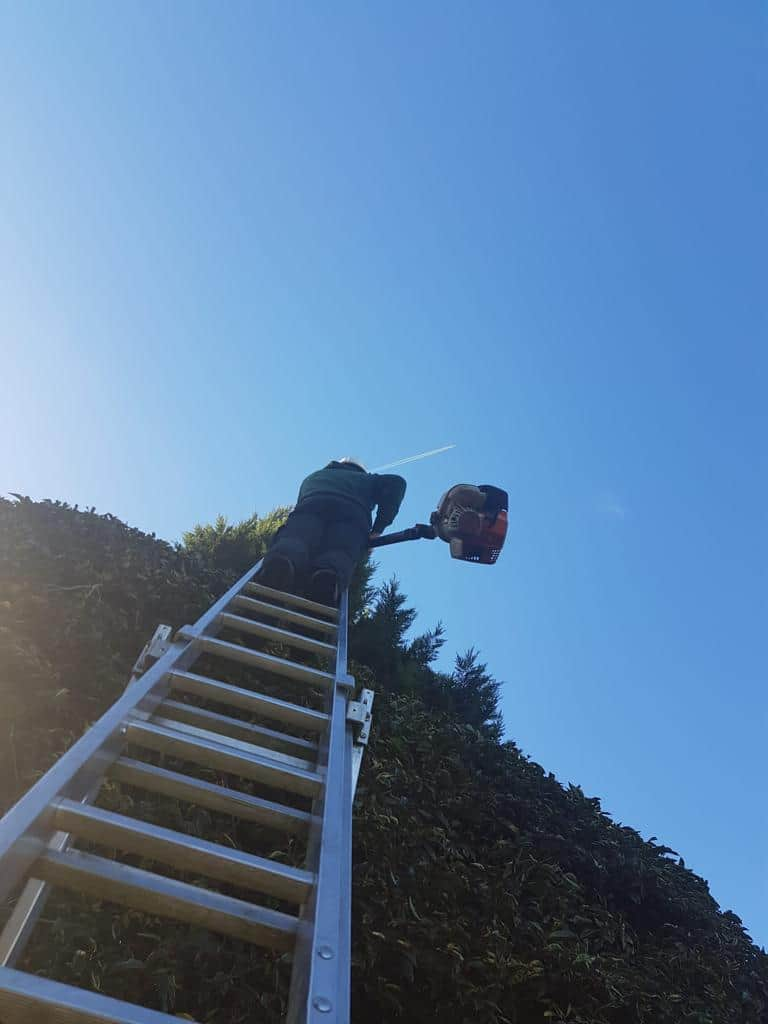
A mature tree can be an attractive and valuable feature within a garden, but its size needs to remain appropriate for its location. As the crown continues to develop, branches may begin extending further across the garden, towards buildings, over access routes or above neighbouring features. In some cases, the increasing size can also affect the balance and manageability of the tree itself.
For property owners in Midhurst, West Sussex, an oversized tree crown does not automatically mean the tree needs to be removed. Professional tree surgery can often manage excessive growth while retaining the tree and maintaining a natural, balanced form.
At LM Tree Surgery Midhurst, assessing the complete tree before recommending work is important because the appropriate solution depends on its species, condition, structure, location and the extent of the crown.
What Is the Crown of a Tree?
The crown is the upper part of the tree consisting primarily of branches, smaller growth and foliage.
As a healthy tree matures, its crown naturally increases in height and spread. This is not necessarily a problem when there is sufficient space around it.
Difficulties can begin when the crown becomes too large for its surroundings.
A tree that was appropriately sized when originally planted may eventually become dominant within a smaller garden as decades of growth accumulate.
When Is a Tree Crown Considered Too Large?
There is no single measurement that determines whether a crown has become oversized.
The important consideration is the relationship between the tree and its surroundings.
Potential warning signs include:
- Branches extending excessively across the garden
- Limbs growing towards roofs or buildings
- Growth obstructing paths or access areas
- The tree dominating a relatively small outdoor space
- Heavy branches extending a considerable distance from the main stem
- Excessive shading beneath a dense crown
- Branches becoming difficult to manage
- The crown appearing noticeably unbalanced
These signs do not necessarily mean the tree is unsafe, but they can indicate that professional assessment would be worthwhile.
Large Branches Can Become Difficult to Manage
As branches continue growing, their length and weight can increase considerably.
Long limbs extending away from the main trunk can become increasingly dominant features within the crown. Their size may also make future pruning more complicated if they are allowed to develop without appropriate management.
Timely professional pruning can help manage growth before branches become excessively large.
This is one reason tree management is often more effective when considered proactively rather than waiting until the tree has significantly outgrown its available space.
An Oversized Crown Can Become Unbalanced
Trees do not always develop perfectly symmetrical crowns.
Available light, surrounding structures, previous pruning and competition from other vegetation can all influence the direction of growth.
A tree may consequently develop much more strongly on one side.
An uneven crown does not automatically indicate a serious structural problem, but substantial imbalance deserves professional consideration, particularly where large limbs extend towards buildings or heavily used parts of the garden.
A tree surgeon can assess the crown structure and determine whether selective pruning or crown reduction would be appropriate.
Excessive Growth Can Bring Branches Close to Buildings
One of the most common practical problems with a large crown is reduced clearance around the property.
Branches may gradually extend towards:
- Roof coverings
- Gutters
- Walls
- Windows
- Outbuildings
- Garden structures
Movement during windy conditions can cause branches to make contact with nearby surfaces.
Rather than repeatedly cutting back individual branch tips without considering the overall tree, professional tree surgery can manage the crown in a more structured way.
Overhanging Branches Can Restrict Garden Space
A tree does not have to physically touch a building to become inconvenient.
Low or spreading branches can gradually occupy significant amounts of usable garden space.
They may extend across lawns, seating areas or paths, making parts of the garden feel enclosed and difficult to use.
Where appropriate, selective pruning can improve clearance while preserving the wider form of the tree.
The objective should be to create a sensible relationship between the tree and the space around it.
A Large Crown Can Reduce Light Levels
A substantial tree canopy can create considerable shade.
Shade is not inherently undesirable and can be one of the benefits of having mature trees. However, a crown that has become exceptionally large or dense for its location may significantly reduce the amount of light reaching the garden below.
This can affect how comfortable certain parts of the garden feel and may influence the growth of vegetation beneath the canopy.
Professional crown management may help create a more suitable balance without unnecessarily removing the tree.
Nearby Trees Can Become Crowded
Problems can also develop when several trees grow close together.
As their crowns expand, branches may begin competing for the same space. Individual trees may then develop unevenly as they seek available light.
Crowded crowns can make it more difficult to distinguish which branches belong to which tree and can create a dense, unmanaged appearance.
Professional assessment allows each tree to be considered individually as well as part of the wider group.
Wind Places Pressure on Large Crowns
The crown is the part of the tree most directly exposed to wind.
A large canopy presents a substantial area to moving air, while long branches can experience considerable movement during strong weather.
Healthy trees are naturally adapted to respond to wind, so crown size alone does not mean a tree is unstable. However, existing structural weaknesses, damaged branches or excessive end-weight can become more significant when combined with a very large crown.
A tree surgeon can assess whether pruning could reduce particular areas of concern while retaining an appropriate amount of healthy growth.
Dead Branches Can Be Harder to Notice in a Dense Crown
Large, dense crowns can sometimes make individual branch problems less obvious from ground level.
Dead, damaged or weakened branches may be partially hidden by surrounding foliage.
This is another reason why professional tree assessment can be useful when a mature tree has become particularly large.
Where necessary, deadwood can be removed independently of wider crown management, helping address specific defective branches without unnecessary pruning elsewhere.
Why Simply Cutting Branches Back Is Not the Best Approach
Tree pruning should not be treated as straightforward cutting.
Removing too much material or making cuts in unsuitable positions can affect the tree’s appearance and future growth.
Different species also respond differently to pruning.
Professional tree surgery considers factors such as:
- Tree species
- Crown structure
- Branch size
- Tree condition
- Natural growth habit
- Surrounding space
- The reason pruning is required
This allows work to be planned around the tree rather than simply making the crown smaller at any cost.
Could Crown Reduction Be the Right Solution?
Crown reduction is one option for managing a tree that has become too large for its location.
The process involves selectively reducing the height and/or spread of the crown while maintaining an appropriate overall shape.
When suitable for the individual tree, crown reduction can help:
- Reduce excessive crown dimensions
- Shorten long or heavily extended branches
- Improve clearance from surrounding features
- Create a more proportionate canopy
- Manage an oversized tree without removing it entirely
The amount of reduction should be determined by the tree’s condition and species rather than an arbitrary percentage chosen purely for appearance.
Crown Reduction Is Different from Removing Large Sections at Random
A professionally reduced crown should still resemble a natural tree.
The aim is not to remove branches indiscriminately until the tree fits within a predetermined outline.
Cuts should be selected carefully, taking account of branch structure and suitable growth points.
This more considered approach helps retain the character of the tree while addressing the practical problems caused by excessive size.
Would Crown Thinning Solve the Problem?
Crown thinning and crown reduction serve different purposes.
Thinning selectively removes branches throughout the crown to reduce density while generally retaining the tree’s overall dimensions. Reduction decreases the height and/or spread.
If the main problem is that branches have extended too far towards a building or across a garden, simply reducing density may not provide the necessary clearance.
A professional assessment is therefore important to establish what type of pruning actually addresses the problem.
Crown Lifting May Help with Low Branches
Sometimes the overall crown is not too large, but its lowest branches are creating difficulties.
Low growth may obstruct paths, lawns or other areas beneath the tree.
In appropriate circumstances, crown lifting can increase clearance by managing selected lower branches.
Again, this is different from reducing the entire crown.
Correctly identifying the actual problem helps avoid unnecessary work to healthy sections of the tree.
When Might Several Tree Surgery Techniques Be Needed?
Mature trees can develop more than one issue at the same time.
For example, a tree might have an excessively wide crown alongside dead branches and low growth restricting access.
In this situation, one type of pruning may not address everything.
A carefully planned programme could potentially combine selective deadwood removal with appropriate crown management.
The important point is that each operation should have a clear purpose based on the condition and location of the tree.
Can Regular Management Prevent a Tree Becoming Unmanageable?
Appropriate periodic pruning can sometimes prevent minor growth issues from becoming much larger management problems.
Smaller, carefully selected cuts can often be preferable to waiting until very large branches require substantial intervention.
However, trees should not automatically be pruned simply because time has passed. The need for work depends on the species, growth rate, condition and surrounding environment.
Professional assessment can help determine when intervention is genuinely beneficial.
Why Professional Assessment Matters
A large crown can look concerning from the ground, but appearance alone does not reveal the complete condition of the tree.
An experienced tree surgeon can consider the tree’s structure, branch arrangement and relationship with nearby features before recommending appropriate work.
At LM Tree Surgery Midhurst, the aim is to manage trees according to their individual condition rather than automatically recommending severe pruning or removal.
Where a tree can be retained and appropriately managed, professional tree surgery can help create a better balance between the tree and the surrounding garden.
When Should You Ask a Tree Surgeon to Take a Look?
Consider arranging a professional assessment if:
- The crown has become disproportionately large for the garden
- Long branches are extending towards buildings
- Limbs are restricting paths or garden access
- The crown has developed noticeably more heavily on one side
- Several large branches concern you
- The canopy has become exceptionally dense
- Previous pruning has resulted in uneven growth
- You are unsure whether reduction, lifting or another form of pruning is appropriate
You do not need to decide what type of tree surgery is required beforehand. Identifying the correct approach should form part of the professional assessment.
Conclusion
A tree crown that becomes too large can create several practical problems. Branches may extend towards roofs and buildings, usable garden space can become restricted, light levels may decrease and an uneven or heavily extended crown can become increasingly difficult to manage.
However, an oversized crown does not automatically mean the tree needs to be felled. Depending on the species, condition and structure of the tree, professional crown reduction or other carefully selected pruning techniques may provide a more appropriate solution.
For homeowners in Midhurst, West Sussex, LM Tree Surgery Midhurst provides professional tree surgery focused on managing trees safely and appropriately for their surroundings. If a tree in your garden has become excessively large or difficult to manage, contact our team to arrange an assessment and discuss the most suitable approach.
Call us on: 01730 771 392
Click here to find out more about LM Tree Surgery Midhurst
Click here to complete our contact form and see how we can help with your tree’s needs.